Honest work for the people doing the hard work.
Hi, I’m Stacy. I’m a trauma-informed therapist, advocate, and creator of clinical tools. Everything here is built on one belief: people heal when they’re seen without correction and known without threat. Whether you’re looking for therapy, resources for your practice, or a voice that tells the truth about the systems that shape us, you’re in the right place.


THE NAME, AND WHY IT MATTERS
Seen without correction. Known without threat.
So many of us learned that being noticed meant being fixed, and being known meant being judged. Seen and Known is the opposite of that. It’s the experience of someone looking at the whole of you, the messy, the contradictory, the parts you were told to hide, and not flinching. That’s where healing starts, and it’s what I try to offer in everything I make, whether it’s a session, a worksheet, or a hard conversation online.
-
You don’t have to perform, explain, or earn your place here. You get to show up as you are.
-
Your story makes sense in context. We get curious about where it started instead of judging where it landed.
-
Healing isn’t a finish line. It’s movement, sometimes forward, sometimes sideways, and all of it counts.

FOR CLINICIANS
Tools built for the room you actually work in.
Every resource here comes from real sessions with real clients. They’re trauma-informed, culturally responsive, and designed to be picked up and used, not studied for a week first.
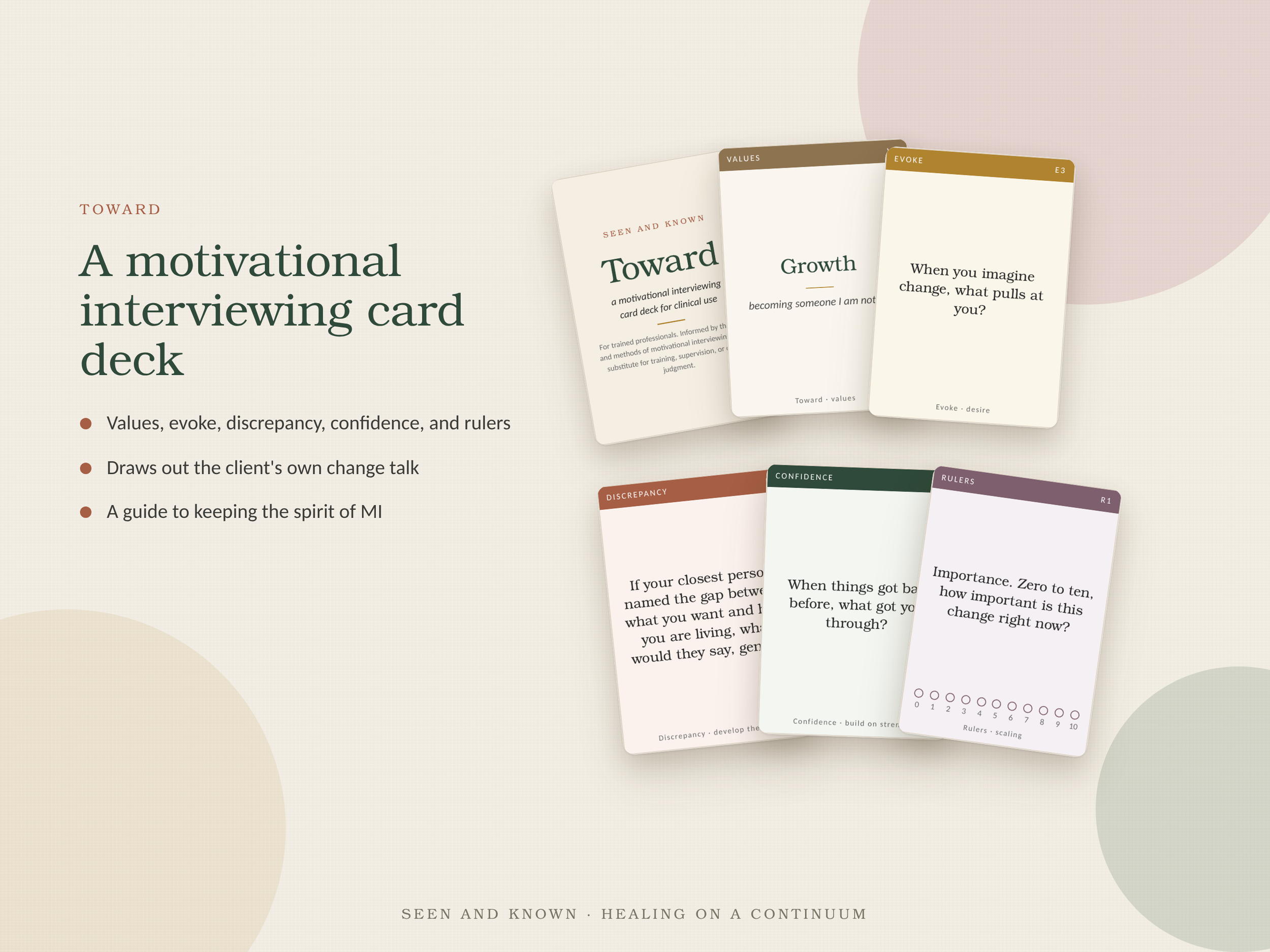
66 cards across five suits to guide motivational interviewing conversations, especially with clients who aren’t sure they want to change. Instant digital download.
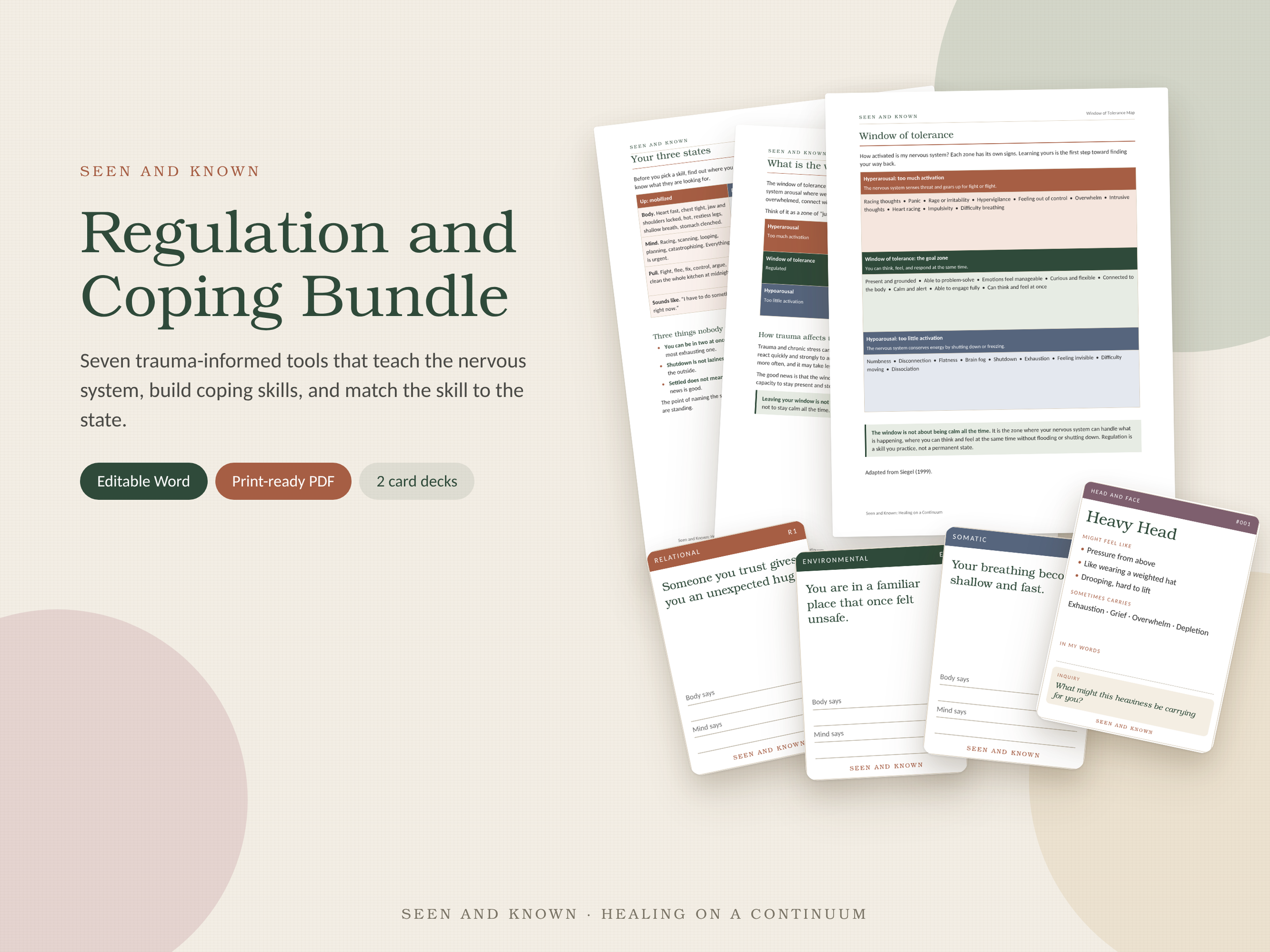
Seven trauma-informed tools that teach the nervous system, build coping skills, and match the skill to the state your client is actually in. Created by a Certified Trauma Professional for real sessions, and ready to print or edit today.
WHAT IS INSIDE
1. Window of Tolerance packet (12 pages). Color-coded zones, zone exploration prompts, early warning signs, a regulation toolkit, and a four-week tracker.
2. Window of Tolerance Map (2 pages). A one-page zone map and a fill-in personal map.
3. Steady: a coping skills workbook for adults (48 pages). Organized by nervous system state, in five parts: regulation, urges, processing, people, and practice. Includes a state map, urge surfing, a lapse plan, boundary scripts, repair steps, and a one-page plan.
4. Thought Circle (4 pages). A creative, contained practice for looping thoughts, with before-and-after ratings.
5. My Happy Meal (5 pages). A playful coping plan clients build before they need it.
6. Safe and Unsafe deck (55 cards). Scenario cards in five categories, with "body says" and "mind says" lines, a sorting mat, discussion prompts, and a debrief page.
7. Sensory Card Library (101 cards plus 4 blanks). Body sensation cards across 12 color-coded regions, each with descriptions, possible emotions, and a gentle question. Includes a clinician guide and a check-in log.
WHY CLINICIANS USE IT
Every resource includes a clinician page with purpose, best fit, pacing guidance, processing ideas, and documentation language. Safety and pacing notes appear wherever a page could stir things up. The tools are integrative, trauma-informed, and neurodivergent-affirming.
WHO IT IS FOR
Therapists, counselors, social workers, and other licensed or pre-licensed mental health professionals working with adults, in person or by telehealth.
FORMAT
Instant digital download: one zip file.
Worksheets come as editable Word files and print-ready PDFs.
Card decks come as print-ready PDFs (2.5 by 3.5 inch and 3.75 by 5 inch cards) with backs and crop marks.
Includes a one-page Start Here guide with the suggested order of use.
US Letter size. No physical item will be shipped.
LICENSE
For one clinician. Print unlimited copies for your own clients and use the files in your own practice. Please do not resell, share, post, or include the files in products for sale.
PLEASE NOTE
These are clinical tools, not a substitute for professional judgment, diagnosis, or treatment. Because this is a digital product, refunds are not available, but please message me if you have any trouble with your files and I will make it right.
Seen and Known: Healing on a Continuum
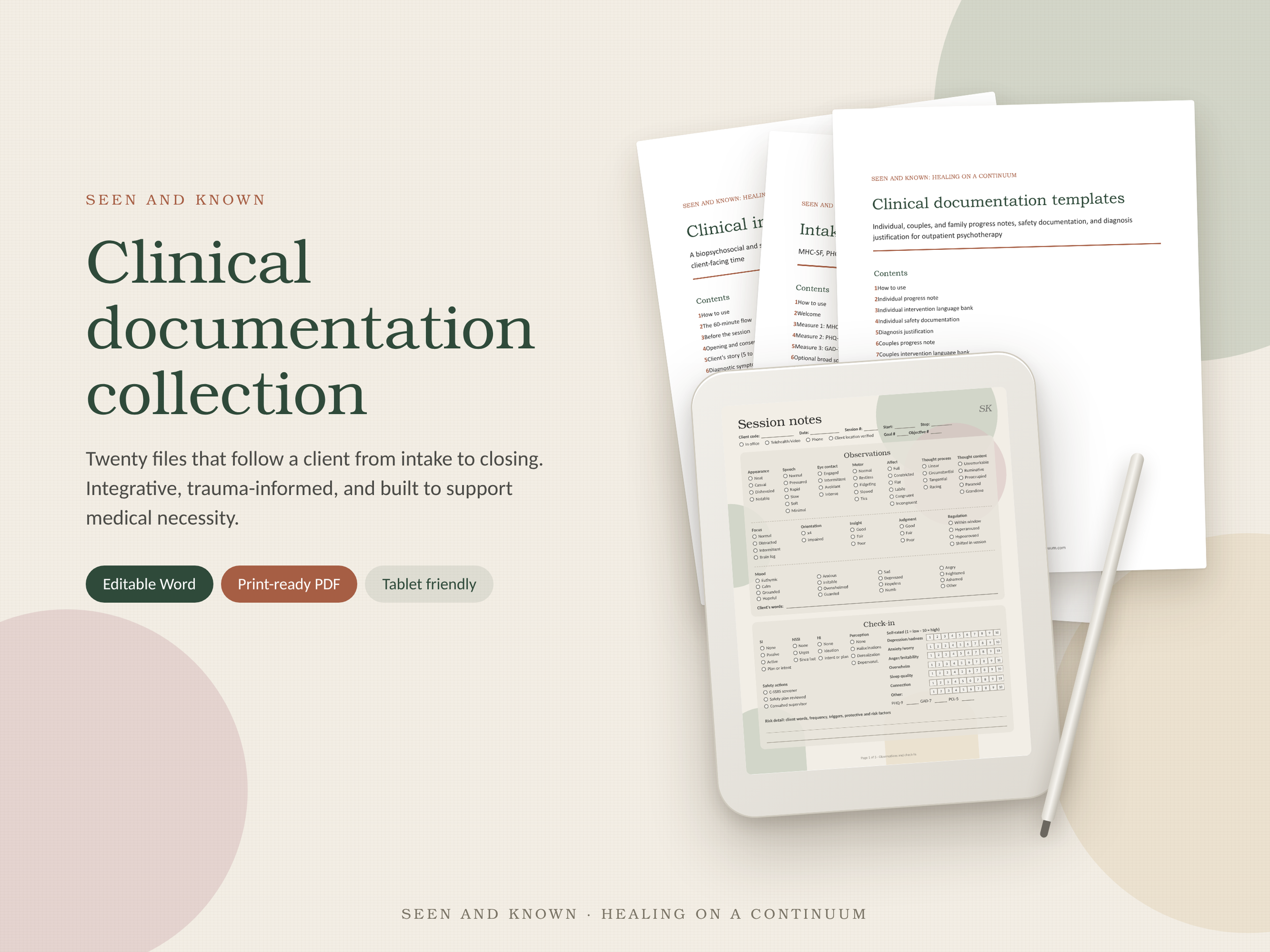
Documentation that sees the whole person and still meets the standard.
The Seen and Known clinical documentation collection follows a client from first contact through closing. It was built by a clinician for outpatient therapists who want notes that honor the work, support medical necessity, and take less time to write.
Every form is integrative and trauma-informed, written in clear clinical language, and organized so that what you mark during session moves straight into your official note.
WHAT'S INCLUDED (20 files)
Intake
- Clinical Intake Interview: a 60-minute biopsychosocial and diagnostic assessment with timed sections and prompts
- Couples and Family Intake: conjoint interviewing with private safety check-ins and EFT cycle mapping
- Assessment Bundle: MHC-SF, PHQ-9, GAD-7, CAGE-AID, LEC-5, and ACE in a trauma-informed order, with scoring guidance and a summary sheet
- Couples and Family Consent: no-secrets and limited-secrets policy options
- Telehealth Emergency Plan
Treatment planning
- Client-facing treatment plan with measurable, numbered objectives
- Client self-review worksheet
- 180-day treatment plan review
Every session
- Individual and conjoint in-session note sheets, designed for tablets and handwriting
- Clinical documentation templates: progress notes for individual, couples, and family sessions; 50-entry intervention language bank; safety documentation statements; diagnosis justification for 25+ diagnoses; relational codes and billing guidance
- Measurement tracker (Excel) with severity flags, change from intake, and automatic trend charts
Safety and risk
- Suicide risk assessment with clinical formulation
- Client safety plan with pocket card
Between sessions
- Contact notes for calls, collateral contacts, coordination, crisis contacts, and missed appointment outreach
- Coordination of care letter
- Supervision notes with licensure hours tracking
Closing
- Discharge summary
- Closing letters for ending together and for clients who stop attending
Plus a collection index showing which file to use at each stage of care.
APPROACHES REPRESENTED
Compassionate Inquiry, Gestalt, person-centered, trauma-informed, somatic, parts and schema work, EFT, DBT adaptations for high-conflict couples and families, ACT, CBT, SFBT, structural and Bowen family therapy, and intersectional practice.
WHO IT'S FOR
Licensed and pre-licensed counselors, therapists, social workers, and psychologists in outpatient practice, group practice, or agency settings.
FILE DETAILS
- Word documents you can edit, plus PDFs ready to print or use on a tablet
- One Excel workbook
- Instant download; nothing is shipped
- Delivered as zip files. Unzip on a computer before opening.
PLEASE NOTE
- Built for Minnesota practice. Minnesota-specific sections, such as the diagnostic assessment crosswalk, are clearly labeled and can be removed or adapted to your state.
- These templates support, but do not replace, clinical judgment, supervision, or legal consultation. Verify requirements with your state board, payers, and agency.
- Assessment measures are reproduced under their developers' free-use terms, with full credit. The BASIS-24 is a licensed instrument and is not included.
LICENSE
Purchase grants one clinician the right to use and adapt these files in their own practice. Please do not resell, share, or redistribute the files. For a group practice license, send me a message.
Because this is a digital product, all sales are final. If anything doesn't open correctly, message me and I'll make it right.
Seen and Known: Healing on a Continuum
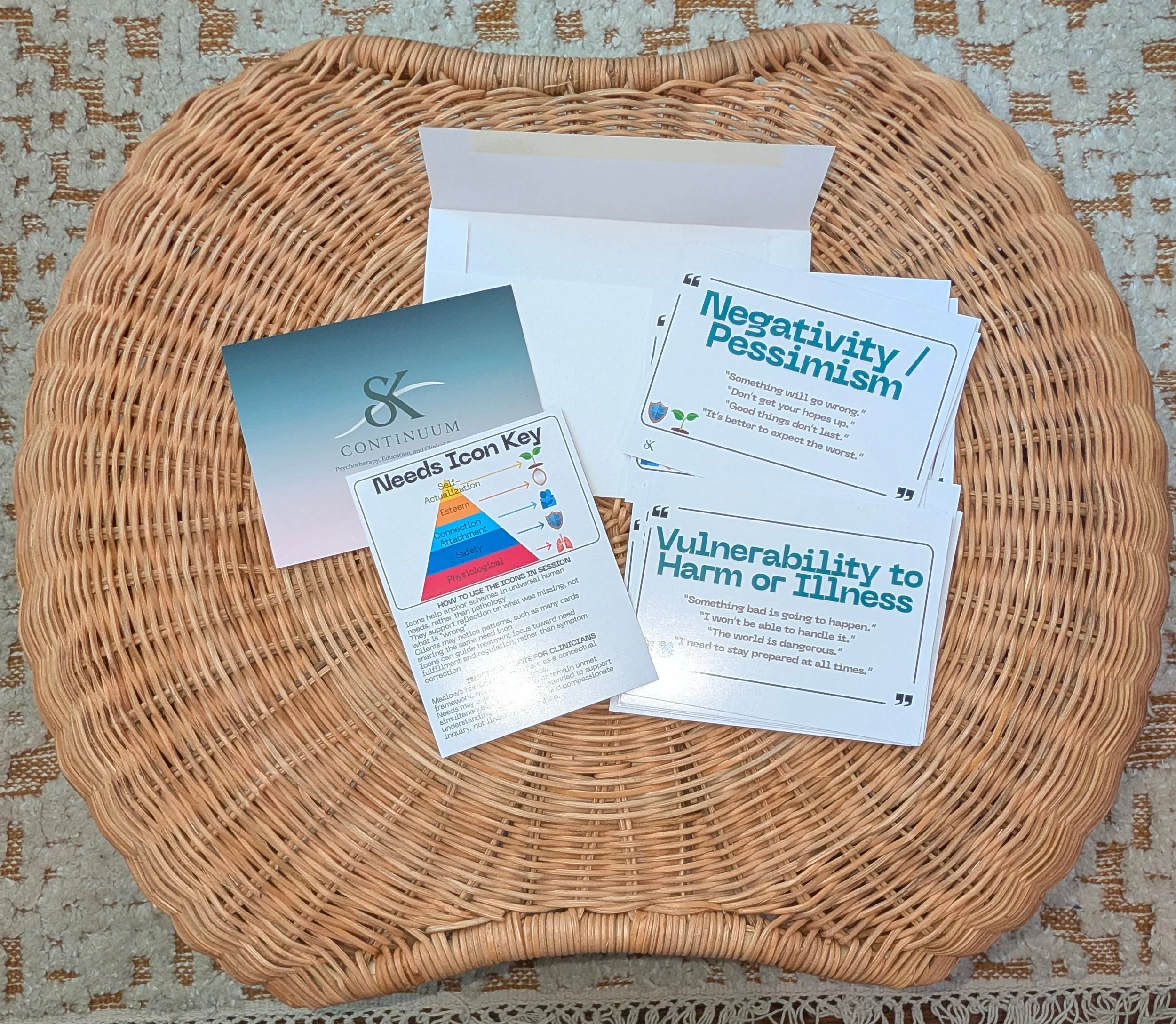
The Schema–Needs Inquiry Deck is a trauma-informed, needs-based clinical exploration tool designed to support collaborative schema work without pathologizing survival.
Rather than framing schemas as deficits, this deck reframes them as adaptive responses to unmet developmental needs, inviting curiosity, compassion, and client agency without asking clients to find meaning in trauma or adversity.
What This Tool Is:
This deck is a clinical inquiry aid, not an assessment or diagnostic instrument. It is intended to support schema exploration through a non-pathologizing, trauma-informed lens that centers unmet needs and protective strategies.
Each card integrates:
Common core thoughts/beliefs
Core unmet developmental needs (using Maslow’s hierarchy as a flexible guide)
Emotional states often associated with the pattern
The original protective or adaptive function of the schema
Gentle inquiry prompts to support reflective, embodied exploration
Schema names are descriptive, not prescriptive. Partial resonance is expected, and clients are encouraged to modify or reject labels entirely.
How the Deck Is Used:
Front-Side Sorting: Clients review the front of each card and sort based on resonance, without pressure to explain or justify.
Selective Exploration: Only cards that resonate are turned over. Exploration focuses on unmet needs, emotional responses, and protective function.
Collaborative Inquiry: The process prioritizes pacing, nervous-system safety, and shared meaning rather than interpretation or correction.
This approach supports depth without overwhelm and curiosity without coercion.
Physical Product Details:
Professionally printed card deck
350 gsm deluxe gloss cardstock for durability and tactile quality
Full-color, double-sided cards
Includes a storage envelope for organization and portability
Intended For:
Licensed therapists and counselors
Trauma-informed clinicians
Educators and supervisors
Coaches working within ethical scope
Advanced graduate-level trainees
Not intended for self-diagnosis, crisis intervention, or replacement of psychotherapy or professional judgment.
Important Notes:
Use within scope of practice and training
A schema tool that centers unmet needs, not pathology.
Built for safety, curiosity, and clinical depth.
Created by SK Continuum
Psychotherapy, Education, and Clinical Resources
Where identity, trauma, and authenticity meet.
Follow on Social
Hard truths, no sugar, a little delirium.
Online, I talk about the stuff we were taught to accept: high-control systems, purity culture, the stories media sells us about love and worth, and what it takes to unlearn them. Sometimes it’s heavy. Sometimes it’s ridiculous. Usually it’s both, because sometimes you have to laugh so you don’t cry.
Ready when you are.
Whether you’re looking for a therapist, a resource for your practice, or a collaborator, reaching out is the hardest part. I’ll take it from there.